The Cell Dynamics and Fragmentation lab at 
We study how single cells move and fragment in complex environments using microfluidics. We bring tools and concepts from physics and chemistry into cell biology to study the cell boundary.
What is cell fragmentation?
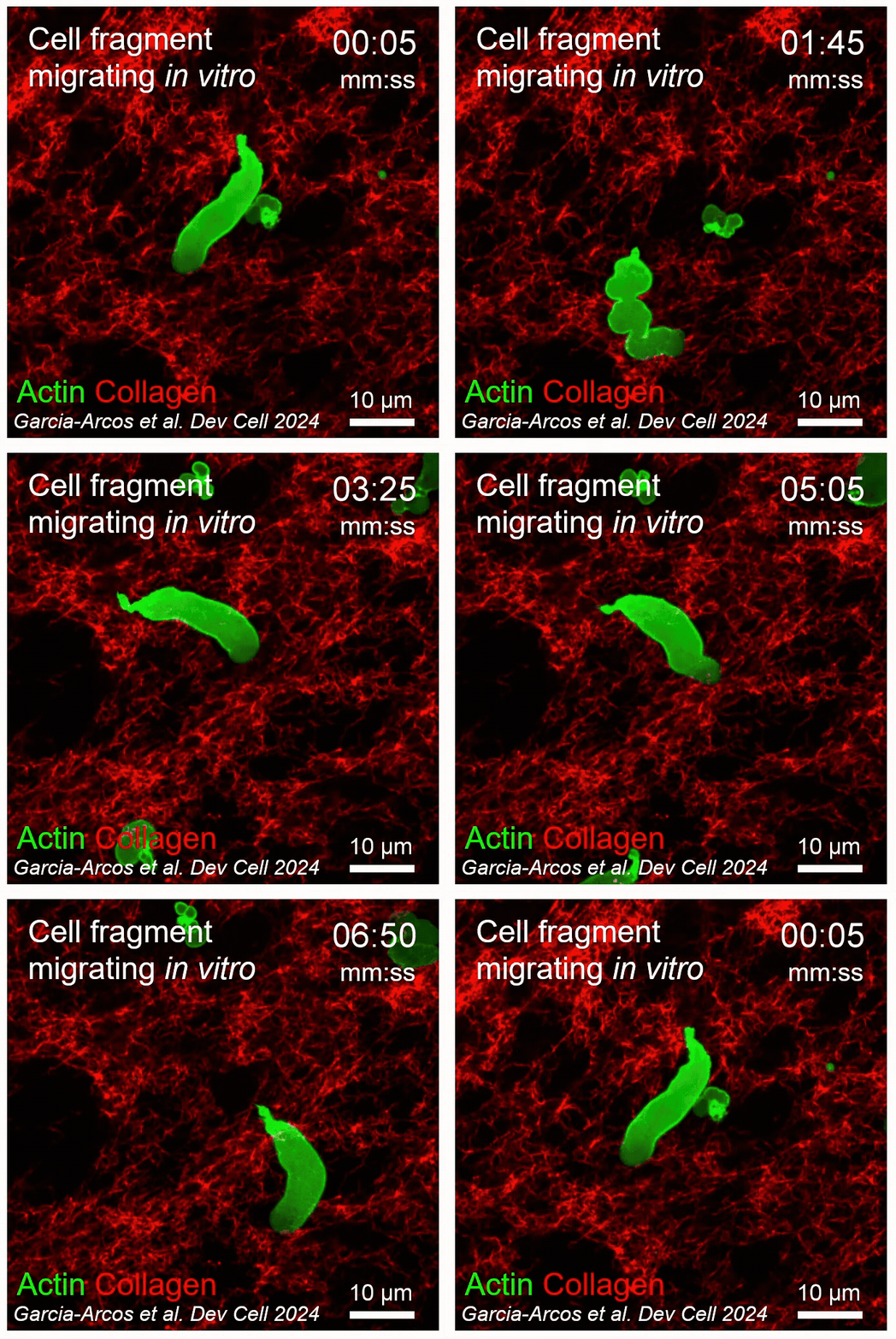
Cell fragmentation refers to the process by which a part of the cell splits forming a cytoplast through a combination of actomyosin contractility and localized membrane scission. Unlike apoptotic bodies or smaller extracellular vesicles, these large fragments can move on their own and are enriched in specific molecules.
Fragmentation occurs in diverse contexts: from cancer cells navigating confined environments to megakaryocytes during platelet formation. These fragments can carry signals, metabolites, or organelles that influence surrounding cells. Our research aims to uncover the molecular and physical principles that generate these fragments, understand what cellular material they carry, and determine how they shape communication, metabolism, and disease progression.
The lab is headed by Juan Manuel García-Arcos. We are generously hosted at the unit of Pierre Gönczy at the School of Life Sciences of the École Polytechnique Fédérale de Lausanne (EPFL) and funded by an Ambizione grant from the Swiss National Science Foundation.
Research topics
Our main focus is to understand how physical and molecular principles control cell behavior, with a particular emphasis on membrane mechanics and cell fragmentation.
People
We value curiosity, clear thinking, and careful experimentation, and we welcome motivated students and researchers who want to grow in a supportive environment.
Publications
Check here our preprints and publications from the lab and with collaborators over the past years.
Teaching
Slides, exercises, and course materials we’ve created for teaching microscopy, scientific writing, and data visualization. Everything is released under a Creative Commons license, so you’re free to use, adapt, and share it!
Art
Scientific illustrations and science-inspired artwork, created regularly alongside our research. These pieces turn what we see under the microscope into images that explain, inspire, and invite reflection.
Open Science
Everything behind our research is openly available on Figshare: papers, code, raw data, microscopy datasets, and 3D printing files. We share it all so others can reproduce, reuse, and build on our work.

We are hiring!
We are always open to host master internship projects and any PhD candidate or postdoc who is motivated by science and interested in our research topics. Come join us in Lausanne, Switzerland!
Funding and support

News and social media wall
New method paper out today on FLIM analysis with Flipper-TR. We discuss fitting strategies, common pitfalls, and quantitative interpretation for measurements. First corresponding/last authorship for me! Free link: authors.elsevier.com/a/1me2hHRzCb… Thanks to @rouxlab.bsky.social and Tithi Mandal!
— Juanma García-Arcos (@juanmagararc.bsky.social) February 18, 2026 at 10:56 PM
[image or embed]
1/3 A few snapshots from the past intense days at the University of Helsinki for our FLIM and FCS course! We combined lectures, hands-on microscopy and analysis with plenty of questions and discussion. A fantastic group of researchers to learn with. 🔬 #FLIM #FCS #Microscopy
— Juanma García-Arcos (@juanmagararc.bsky.social) September 10, 2026 at 11:48 PM
[image or embed]
New at EPFL this October: We are launching a different PhD course 🧪📊 BIO-707 is almost lecture-free: bring your own data, build better figures + a story, get peer feedback, revise, repeat. Supported by the teaching development funds at EPFL and CAPE 🙌 3 spots left! edu.epfl.ch/coursebook/e…
— Juanma García-Arcos (@juanmagararc.bsky.social) August 25, 2026 at 1:07 PM
[image or embed]